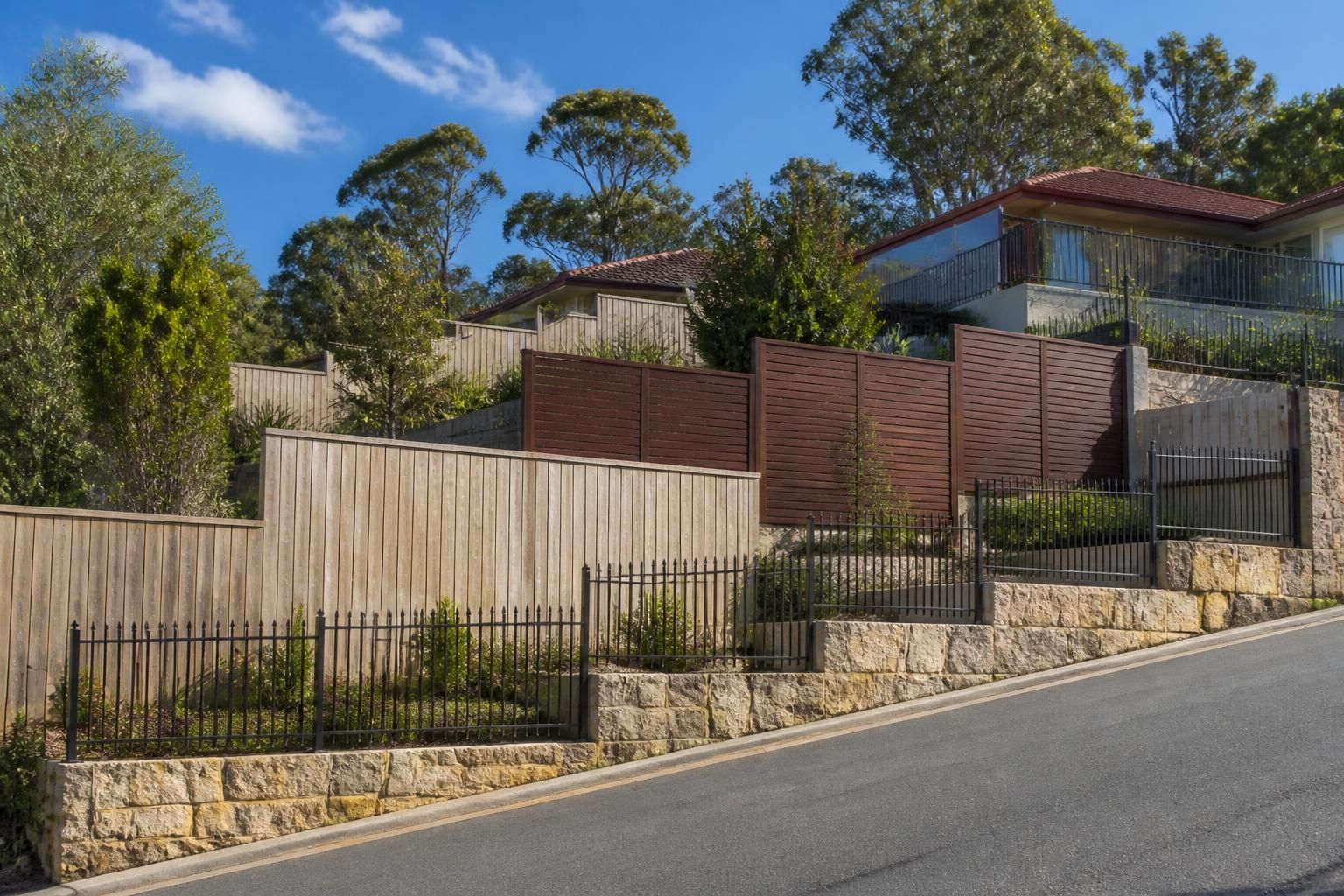
Australia’s diverse landscapes often present homeowners with the challenge of fencing sloping blocks, from steep hillsides to gently undulating grounds. Selecting the best fence options for sloping blocks involves weighing aesthetics, durability, and functionality to ensure long-lasting results. With property boundaries that must be secure yet visually pleasing, mastering slope fencing techniques and choosing materials suited for uneven terrains is vital. This comprehensive guide delves into practical solutions, including the use of colorbond fencing, timber fencing, and retaining wall fences, helping you navigate the complexity of sloping land installations in Australia.
Key Points to Consider:
- Understanding the differences between raked and stepped fence installations for slopes.
- Choosing the right fencing material—such as Colorbond or timber—based on slope severity and design preferences.
- The importance of bracing techniques and structural supports on uneven terrain to maintain fence integrity.
- How retaining wall fences can simultaneously resolve slope stability and boundary demarcation.
- Complying with local regulations and safety standards, especially for pool fencing on sloping blocks.
- The advantages of professional installation versus DIY for complex slope sites.
Understanding Slope Fencing Methods: Raked Versus Stepped Installation
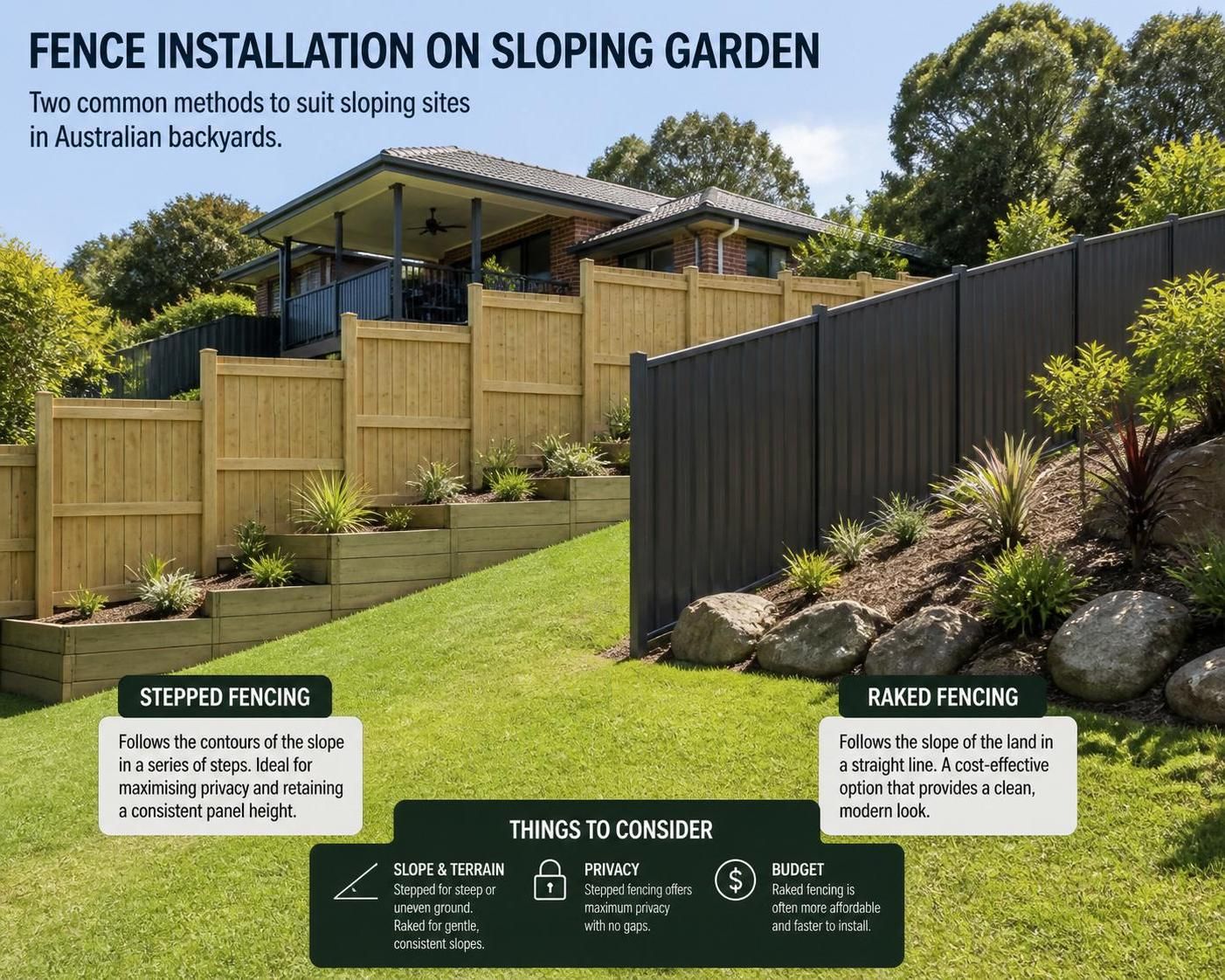
Fencing on sloping blocks in Australia often requires adapting traditional fence installation techniques to follow the contour of uneven terrain. The two primary approaches to slope fencing are the raked method and the stepped method, each with distinct benefits and challenges.
The Stepped Method
This approach involves installing fence panels in a sequential, “stair-step” fashion down the slope. Each fence panel remains completely horizontal and level, but is set lower or higher than the adjacent panel to accommodate the change in ground height.
This traditional method suits steep slopes and rigid panel fences like Colorbond, which rarely lend themselves to contouring because their solid sheets cannot be easily angled without impacting the warranty or causing damage. Stepped fencing creates a structured, geometric aesthetic that many homeowners appreciate for its clean lines.
The main drawback of the stepped style is the triangular gap created between the bottom of the horizontal panels and the sloping ground. These gaps may compromise security and privacy by allowing pets or intruding weeds underneath. To counter this, installers often add plinth boards, sleepers, or low retaining walls beneath each step to close gaps and retain soil, further enhancing the fence’s structural integrity.
The Raked Method
Also known as contoured fencing, the raked method aligns the fence panels to slope along the terrain’s rise and fall. Rails are angled to mimic the incline, while the posts remain vertical. This results in smooth, flowing lines with no gaps at the base, which is excellent for pet containment and aesthetic integration with the natural landscape.
Raked fencing works best on gentle to moderate slopes and with flexible materials such as aluminium slat or custom timber fences. The technique can be costlier and more labor-intensive, as it often requires custom fabrication to ensure accurate contoured panels.
Despite its price, the raked method offers consistent fence height across the property boundary and a sleeker appearance, blending in more naturally with your garden fencing scheme.
When deciding between the two, it’s crucial to consider slope severity, security requirements, and budget constraints. You can explore expert comparisons such as those provided by Redlands Fencing Qld for tailored advice on which method suits your block best.
Material Choices for Sloping Blocks: What Works Best in Australia?
Australia’s climate and diverse terrain necessitate selecting the right fencing materials fitted for sloping conditions. Common options include Colorbond, timber, aluminium, and tubular steel fencing. Each comes with distinct properties affecting durability, maintenance, and installation complexity.
Colorbond Fencing: Durable and Popular
Colorbond fencing is a standout choice for sloping blocks, especially for steep gradients where durability and maintenance-free materials are priorities. It is made from pre-painted steel panels, offering robust weather resistance, high security, and a modern aesthetic prized by many Australian homeowners.
However, due to its rigidity, Colorbond is typically installed using the stepped method, as modifying its solid panels to rake over uneven ground can compromise warranty coverage. This makes employing proper bracing techniques crucial on slopes to maintain panel alignment and prevent leaning.
Furthermore, Colorbond fences excel in Brisbane and Newcastle’s varied topographies, as local installers like those mentioned on A1 Fencing Solutions expertly tailor installations to challenging terrains.
Timber Fencing: Classic Look with Flexibility
Timber fencing remains a favored choice for sloping Australian blocks due to its natural appeal and adaptability. It can be installed using either the raked or stepped method, depending on the wood type, slope, and design vision. Custom timber picket fences can be fabricated to follow contours gracefully, delivering an inviting, warm aesthetic compatible with garden fencing.
Timber requires more maintenance than steel or aluminium, especially in moist or termite-prone regions, but advances in treatment and quality framing techniques have helped extend timber’s lifespan on slopes.
Aluminium and Tubular Steel: Lightweight and Sleek
For moderate slopes, aluminium slat fencing and tubular steel fences offer lightweight frameworks that suit raked installations well. Their flexibility allows for easier angular adjustments following the slope without the heavy infrastructure steel requires.
Besides aesthetic advantages, aluminium fences resist rust and corrosion, making them suitable for coastal or wet regions in Australia where weather conditions challenge other materials. The cost, however, can be higher depending on custom fabrication and installation scope.
| Material | Best Installation Method | Pros | Cons |
|---|---|---|---|
| Colorbond | Stepped | Durable, low maintenance, secure | Rigid panels; cost of stepped installation |
| Timber | Stepped or Raked | Natural look; flexible design | Needs upkeep; vulnerable to pests and weather |
| Aluminium Slat | Raked | Lightweight; corrosion resistant | Higher cost; limited for steep slopes |
| Tubular Steel | Raked | Strong and sleek | Can be costly; may require professional installers |
Before installation, consider checking out specialized resources such as comparisons of timber versus Colorbond fences in Australia for clearer insight into cost and maintenance expectations.
Essential Bracing Techniques and Retaining Wall Fence Solutions
Sloping blocks in Australia not only pose challenges to the fence’s visual harmony but also to its structural strength. Uneven ground increases soil pressure on posts and panels, demanding additional bracing techniques and sometimes integrative retaining wall fences.
Bracing for Stability
On inclined terrain, gravity exerts uneven forces that can cause posts to lean or fences to warp eventually. Installing sturdy braces—angled supports connecting posts to the ground or adjacent posts—is critical. Bracing not only enhances rigidity but also prolongs fence lifespan by counterbalancing soil movements and water runoff effects.
Professionals often employ stronger footings or post concretions deeper in the soil on steep slopes to bolster overall stability. This precision reduces risks of future lean or collapse, a common pitfall in DIY projects.
The Retaining Wall Fence Hybrid
In many cases, fences on sloping blocks also serve as low retaining structures. Integrating retaining wall fence elements helps hold back soil, preventing erosion while providing a solid, attractive boundary. Materials like treated pine sleepers (H4 rated for in-ground use) or concrete plinths are often placed underneath stepped fences to fill gaps and sustain soil load.
For slopes with significant elevation changes, a dedicated retaining wall combined with a fence might be necessary. This hybrid approach requires council approval in some Australian states due to its impact on land stability and water drainage. Considering local regulations early ensures smooth installation and ongoing compliance.
Regulatory and Compliance Considerations for Fencing Sloping Blocks in Australia
Installing fences on sloping land intersects with various Australian regulations, especially for properties featuring pools or close to public boundaries. Ensuring compliance avoids costly modifications and fines.
Queensland’s pool fencing laws, for example, mandate an effective fence height of at least 1.2 meters measured from the ground at every point. This complicates slope installations, as an uneven ground level can unintentionally reduce perceived fence height in places—creating non-compliance risks. Consulting with fencing contractors knowledgeable in regional regulations, such as those servicing Brisbane and surrounding areas, is invaluable. You might find insights on compliance and installation in guides like Queensland pool fence height requirements.
Additionally, some councils in Australia require approval before erecting fences exceeding certain heights or using retaining walls. Before commencing any work, verify local legislation to ensure your project meets all requirements. This is especially relevant when constructing retaining wall fences to manage soil erosion on slopes.
Professional Installation Versus DIY on Slope Fencing Projects
While many homeowners consider DIY solutions to save costs, slope fencing in Australia typically demands expert superintendence. The precision needed to keep posts plumb, maintain the intended fence height, and correctly measure for stepping or raking often exceeds typical DIY skillsets.
Professional installers bring technical know-how in measuring slope angles, soil analysis, and bracing techniques critical to fence longevity. Their equipment and experience reduce installation time and potential errors that could lead to costly replacements.
Consider the example of a Sydney homeowner who attempted a DIY Colorbond fence installation on a sharply sloped block. Without adequate bracing, the fence’s posts began leaning within months due to soil shifting and water runoff. In contrast, professional services such as Diamond Fence offer tailored slope fencing options optimized for Australian terrain.
When looking for trusted providers on sloping fence options near you, researching and speaking to local experts ensures your property boundary is secure, visually harmonious, and built to last.
Understanding the best fencing solutions on sloping or uneven terrain is essential to protect your property while enhancing its look. Detailed installation guides, like the one from Northside Fencing, emphasize balancing structural integrity with aesthetic appeal.
Is it more expensive to fence a sloping block compared to a flat one?
Yes, sloping blocks often require additional materials, complex installation methods, and potentially retaining structures, which can raise costs compared to flat blocks.
Can Colorbond fences be raked to follow the slope?
Colorbond fences are usually installed using the stepped method due to their rigid panels. Custom raking is possible but not common because it is labor-intensive and may void warranties.
How can I prevent pets from getting under a fence on a slope?
Using the raked fencing method eliminates gaps at the bottom. If stepping is used, installing plinth boards or sleepers under the steps closes gaps to contain pets effectively.
When is a retaining wall necessary for fencing on a slope?
A retaining wall is recommended when you need to manage significant soil movement or erosion under the fence, especially if the soil retention required exceeds 400mm.
Do I need council approval to fence a sloping block in Australia?
Depending on local regulations and the type of fence or retaining wall, council approval might be required, especially for fences above a certain height or those combined with retaining structures.